“The dress code is smart casual.”
Helpful… sort of.
Does that mean trainers? Jeans? A blazer? A suit without a tie? And what happens when your idea of “smart casual” is completely different from your new manager’s?
What we wear to work has changed significantly. Hybrid working, more relaxed workplaces and changing attitudes towards personal style mean the old rules aren’t always much help.
But what you wear can still matter, particularly for a job interview, your first day or a client-facing role.
So, let’s make getting dressed for work one less thing to think about.
What are the main workplace dress codes in Northern Ireland?
You’ll usually come across some variation of:
- Business formal
- Business professional
- Business casual
- Smart casual
- Casual
- Uniform or role-specific workwear
The difficulty is that companies don’t always mean exactly the same thing when they use them.
A Belfast law firm and a creative agency might both describe their dress code as “smart casual” while having quite different ideas about what that looks like.
The culture of the organisation matters as much as the label.
Here’s a useful starting point.
Business formal
This is the smartest end of the workplace spectrum.
Think traditional corporate clothing: tailored suits, formal dresses or equivalent professional separates, shirts, smart shoes and restrained accessories.
You’re most likely to encounter business formal dress in particularly traditional or senior professional environments, important meetings, formal corporate events or some client-facing situations.
For an interview where you know the organisation is particularly formal, it’s normally better to arrive slightly smarter than necessary than significantly more casual than expected.
Think: polished, professional and considered – the smartest version of your working wardrobe.

Business Professional
Business professional is still formal, but there’s usually a little more room for individuality.
Typical options could include:
- A suit
- Tailored trousers
- A smart skirt or dress
- A shirt or blouse
- A blazer
- Smart knitwear
- Loafers, flats, boots or other smart shoes
You don’t necessarily need every element of traditional corporate dress, but the overall impression should be professional.
You’ll commonly see this type of clothing in corporate, financial, legal, professional services and senior client-facing environments.
Think: smart and authoritative, with a little more room to make it your own.
Business Casual
Here’s where things become less obvious.
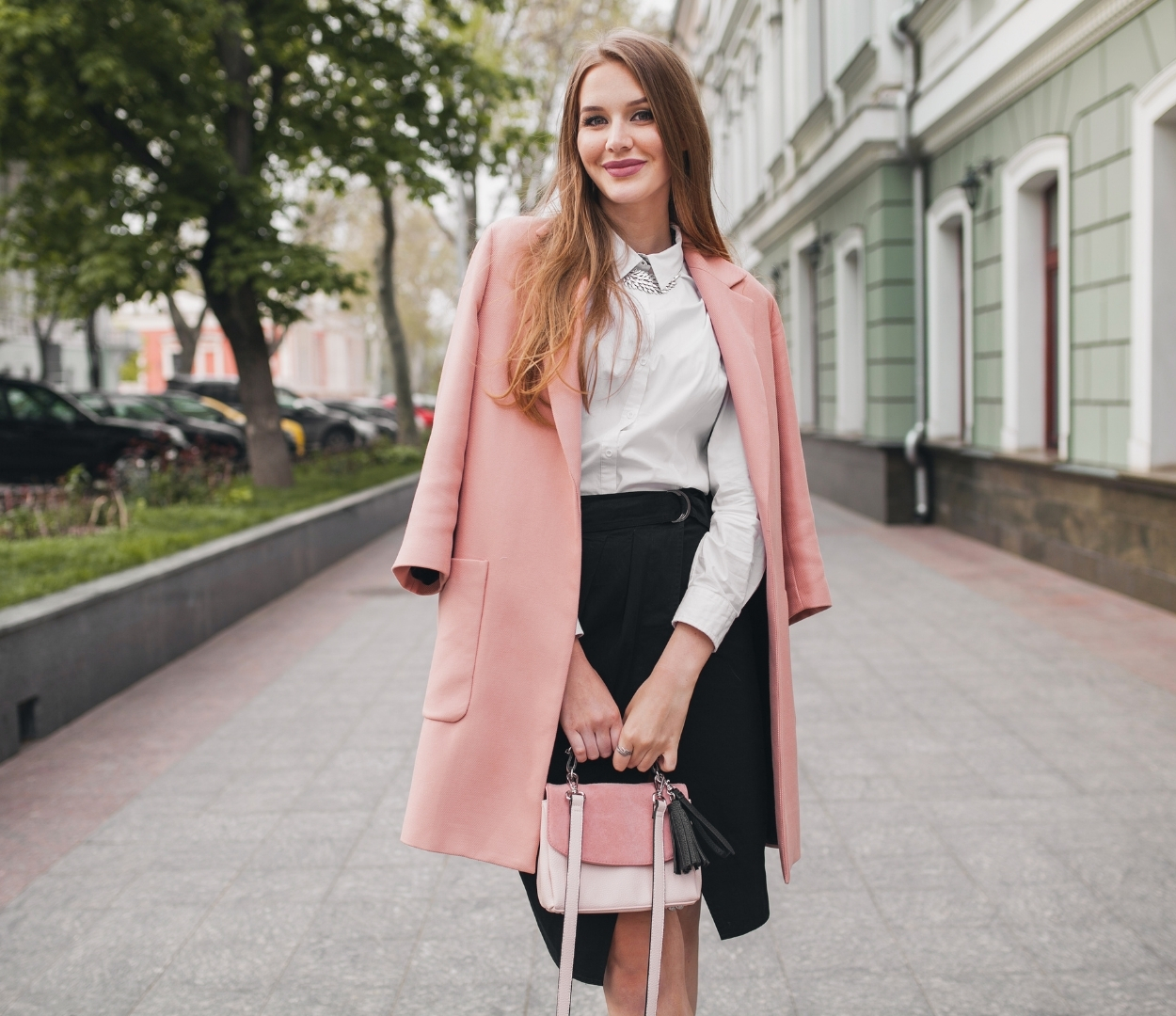
Business casual is essentially professional clothing with some of the formality removed.
You might wear tailored trousers or chinos with a shirt, blouse, smart knit or polo. Dresses, skirts, blazers, loafers, boots and other polished but less formal pieces can all work too.
A full matching suit usually isn’t necessary.
Business casual has become common because it gives people room to be comfortable while still looking professional.
The important word isn’t actually “casual”.
It’s business.
You’re still dressing for work.
Think: professional without the full suit – smart enough for business, relaxed enough for every day.

Smart Casual
Smart casual gives you more freedom again.
It combines relaxed pieces with smarter ones so that the overall outfit still looks intentional and work-appropriate.
Depending on the workplace, that might mean:
- Smart trousers with a knit
- A skirt and simple top
- A relaxed dress
- Chinos and a shirt or polo
- Dark, neat jeans with a blazer
- Clean, understated trainers with otherwise smart clothing
The safest rule?
Don’t judge one item in isolation. Look at the whole outfit.
Trainers with tailored trousers and a smart shirt can look completely different from trainers with joggers and a hoodie.
And remember that “smart casual” isn’t universal. One employer’s everyday outfit can be another employer’s dress-down Friday.
Think: relaxed but put-together – comfortable pieces styled with work in mind.

What does a casual office dress code mean?
Casual workplaces give employees much greater freedom over what they wear.
Jeans, trainers, T-shirts and more relaxed clothing may all be completely normal.
But casual doesn’t mean anything goes.
Clothes still need to be appropriate for your role, workplace and whatever you’re doing that day. Meeting an important client might call for something different from spending the day working internally with your team.
It’s also worth remembering that you’re still in a shared professional environment. Clothing featuring potentially offensive slogans or imagery is best avoided, as is anything that could be seen as culturally or politically sensitive. In Northern Ireland in particular, that can include football shirts, sports tops or clothing carrying symbols that could be associated with a particular community, political viewpoint or identity. Even when there’s no offence intended, work is rarely the right place to test how something might be interpreted.
If you’re unsure, keep it neutral and use the workplace around you as your guide.
Think: comfortable and individual, without forgetting where you are.

Work Attire FAQs
Can you wear jeans to work?
Possibly.
Jeans are now perfectly normal in many UK workplaces, particularly those with casual or smart-casual dress codes.
But there is a considerable difference between workplaces.
If you’re unsure, dark or plain jeans tend to sit towards the smarter end of the scale. Very distressed or heavily embellished denim may feel too casual for some professional environments.
For an interview, we’d be more cautious unless you already know that jeans fit the organisation’s culture.
Can you wear trainers to the office?
Again, it depends.
Clean, simple trainers are common in many modern offices and can work perfectly well with smart-casual clothing.
In more traditional corporate or client-facing environments, smarter footwear may still be expected.
The trick is to read the room – preferably before you’re standing in it.
What should you wear to a job interview?
If you don’t know the company’s dress code, aim towards the smarter end of what you believe employees normally wear.
That doesn’t automatically mean wearing a suit.
Your objective is to look as though you’ve understood the environment and made an effort for the meeting.
Research the company before your interview. Look at its website, LinkedIn page and team photographs if they’re available. Consider the industry, role and people you’re likely to meet.
And if you’re working with us, ask your consultant before your interview.
At Honeycomb, we know the employers we’re recruiting for. That means we can often tell you far more than the time and location of your interview. We can help you understand the environment you’re walking into and what the employer is likely to expect.
What should you wear on your first day at a new job?
Your first day can actually be trickier than your interview.
You got the job. Brilliant.
Now you’ve got a new question: what does everyone actually wear?
If the company hasn’t explained its dress code, ask before you start. It’s a completely reasonable question.
If you’re still unsure, go slightly smarter on day one. Once you’re there, you’ll quickly understand what colleagues wear and how much flexibility you’ve got.
Your first week is for learning the unwritten rules as well as the written ones.
What about working from home?
Working from home changed the relationship many of us have with workwear, but a video call is still a professional interaction.
You don’t need to recreate formal office wear at the kitchen table. You do need to think about who you’re meeting and why.
An internal catch-up with colleagues and a video interview for your next job aren’t the same occasion.
Dress accordingly.
And yes, what you’re wearing below camera level is completely your business only.
Just be certain you won’t need to stand up!
Dress for the diary, not just the office
One of the most useful approaches to modern workwear is to stop thinking that every working day requires the same uniform.
Look at your diary.
Big presentation? Client meeting? Interviewing candidates? Internal planning day? Working from home?
Different days can call for different choices.
Your clothes should help you get on with your job, not become another job to manage.
Workplace dress codes should work for people too
Dress codes aren’t only about deciding whether trainers are acceptable.
Employers should think carefully about whether their policies are inclusive and whether requirements could disadvantage employees because of characteristics protected by discrimination law.
Religious clothing, disability-related requirements, gender and other individual needs can all be relevant. Employers should make sure workplace policies are fair, proportionate and flexible enough to accommodate people appropriately.
For candidates and employees, the important point is this: professional doesn’t have one single look.
A good workplace dress code sets an appropriate standard without unnecessarily restricting the people doing the work.
The Honeycomb rule: understand the room, then dress as though you belong in it
There isn’t one perfect outfit for work.
There isn’t even one definition of smart casual.
What matters is understanding the organisation, the occasion and the role.
Looking for your next business support opportunity? Honeycomb is the local specialist in business support recruitment, connecting talented people with organisations across Northern Ireland.
From preparing for the interview to understanding the company behind the job, we’ve got you.